
Summer can look expansive without being empty. A broad area of sea holds small changes in tone; a meadow gathers many separate lines into one moving surface. In this collection, space and density sit beside each other. The connection is a sense of light with room to spread.
The horizon is a proportion
In the open-sea photograph, the horizon is a very small element with a large compositional role. It divides the frame into two unequal fields. The sea is comparatively even; the sky is interrupted by cloud. Move your attention between those areas and the image begins to feel less like a view of a place and more like an arrangement of different kinds of space.
Neither half needs a central object to be worth looking at. The broad blue areas make small variations easier to notice: a cloud’s soft lower edge, a faint change near the horizon, a darker band of water. There is information here, but it asks for a slower kind of reading.
A coast drawn in several lines
The coastal photograph gives the eye more edges to follow. Land meets water along an irregular boundary. Breaks of pale foam make another set of lines, close to the shore but never identical to it. The upper boundary of the headland cuts into the sky. These contours overlap without becoming one continuous outline.
Look at the colours on either side of the waterline. Blue-green water sits beside muted grasses and stone. The difference is striking, yet the photograph holds together because its colours are moderated by the same light. A coastal image does not need maximum saturation to convey the openness we associate with summer.
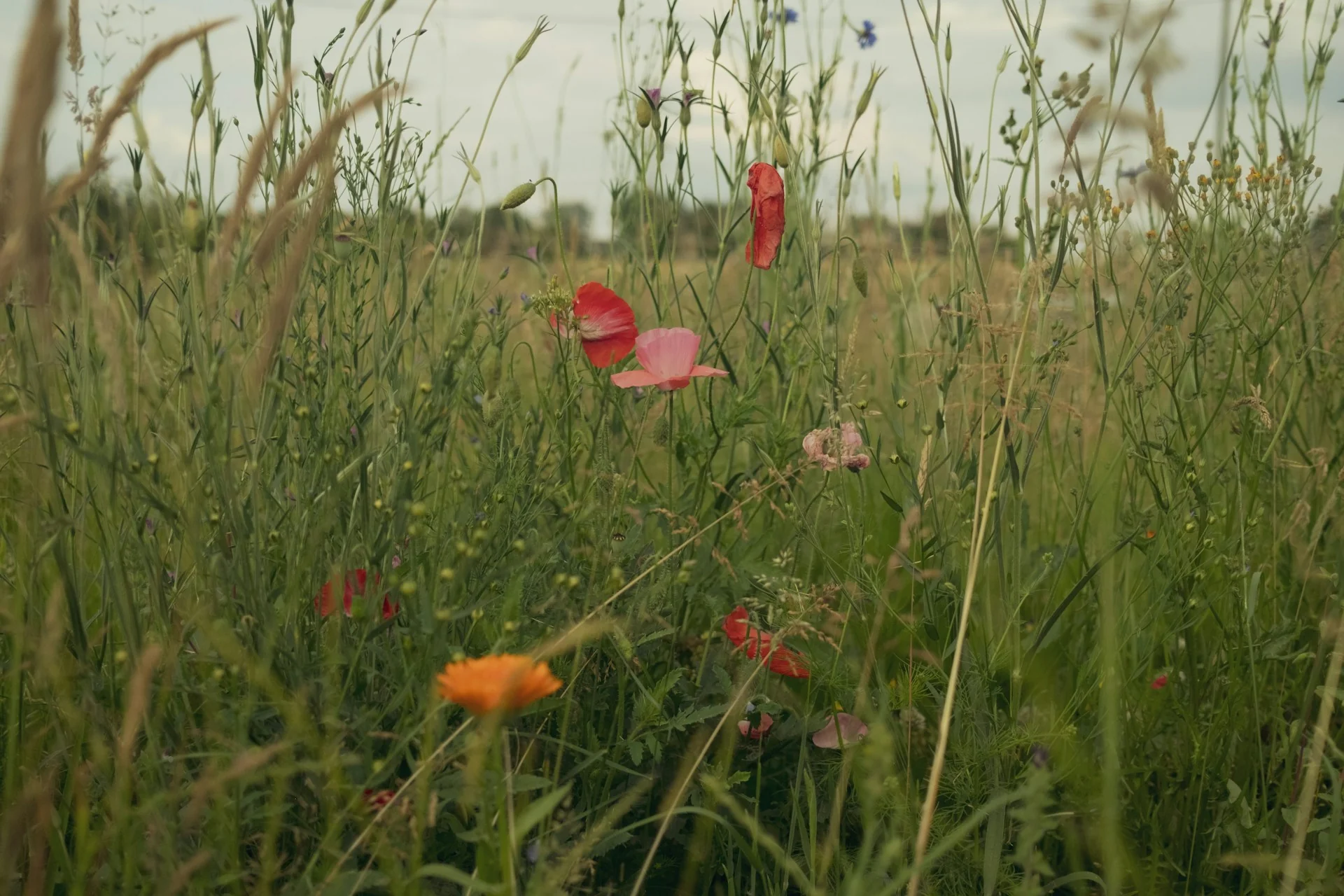
The meadow is not a pattern
From a distance, a meadow can read as a single texture. Nearer the frame, separate stems become visible, changing height and direction. A small flower interrupts the green. Another falls outside the plane of sharp focus. The effect comes from variation rather than from evenly spaced repetition.
There is no need to identify every plant to examine the picture carefully. Follow a line, notice its thickness, and see whether it crosses another. Compare the areas where stems gather with the softer background. The photograph offers a useful counterpoint to the wide sea: a full frame can create breathing room through softness and small intervals.
A sequence of different densities
Try reading the three summer photographs in a different order. Begin with the meadow, where many stems share the frame. Move to the coast, where texture gathers on the land while water opens beside it. Finish with the sea and sky, where two broad areas take up most of the picture. The sequence gradually reduces the number of separate forms asking for attention.
Then reverse the order. Small details in the meadow may feel more noticeable after the open sea. Nothing in the individual files has changed, but the preceding picture affects what you are ready to notice. This is one reason a small collection can reward a return visit. The relationship between photographs offers another way of looking, alongside the details contained in each frame. There is no correct sequence to discover; each order places a different emphasis on the same material.
Let the middle stay quiet
Many summer pictures are built around a dramatic sun or a spectacular view. These selections also make space for less eventful surfaces. A quiet middle allows the edge of a cloud or a modest patch of colour to carry more weight. The absence of a dramatic focal point can be a compositional choice.
The season labels here are a way to connect images, not a report of current weather or a guide to a destination. Summer does not arrive in the same form everywhere. Read this collection as a set of visual associations: an open horizon, light on water, grasses reaching into a soft background. Let those associations stay specific to what the photographs show.